
Howard County Parole Versus Probation
Parole follows release from a Texas prison before the sentence has fully run. The Texas Board of Pardons and Paroles makes the release decision, while the TDCJ Parole Division supervises the person in the community. Mandatory supervision is another state-prison release path governed by statute and Board review. Both remain state matters. Probation, formally called community supervision in Texas, comes from a court order. Howard County probation is administered locally by the 118th Judicial District Community Supervision and Corrections Department, or CSCD, for Howard, Martin, and Glasscock Counties.
These terms cannot be swapped. A judge may place a person on probation without a prison release. A parolee remains subject to a state sentence after leaving prison. The source record identifies which path applies.
| Question | Parole or mandatory supervision | Probation |
|---|---|---|
| Who orders it? | Texas Board of Pardons and Paroles | The sentencing court |
| Who supervises it locally? | TDCJ Big Spring District Parole Office | 118th Judicial District CSCD |
| Best status record | TDCJ offender detail and parole-review result | Judgment, supervision order, and later court orders |
| How it ends | TDCJ discharge or Board action | Court-ordered discharge or expiration |
- Parole
- Conditional release from state prison while part of the sentence remains.
- Probation
- Court-ordered community supervision, which may be imposed instead of confinement.
- Discharge
- The formal end of a sentence or supervision term.
- Absconder
- A person alleged to have stopped reporting or left supervision without authorization. The label does not by itself prove revocation.
Check Howard County Release Supervision
Begin with the custody system that released the person. A TDCJ number or State Identification number produces a more exact state match than a name alone. The TDCJ Inmate Information Search may show custody status, location, projected release information, parole eligibility, and parole review details. Eligibility is only the point when review may occur. It is not approval and not proof of release.
- Search TDCJ by TDCJ number, SID, or full name. Use date of birth to separate same-name records.
- Read the custody status and location with every date. A past or projected date alone does not show that release occurred.
- Open Parole Review Information and compare any result with the Board's official result channels. The status line is 844-512-0461.
- If a favorable vote appears, ask TDCJ Review and Release Processing at 512-406-5202 whether conditions have been met and release was completed.
- For probation, obtain the judgment or supervision order from the correct Howard County clerk, then ask the 118th Judicial District CSCD to route a permissible status question.
- Confirm the end of supervision with a discharge entry or court order. Do not infer discharge from silence or a missing web result.
Texas has no broad public name search for every county probationer. Court records matter here. They may show an original community-supervision order, a modification, a motion to revoke, or a discharge. The CSCD can limit personal details, so ask for the office and public record rather than private schedules or residence information.
Howard County Supervision Offices
Big Spring has two offices whose names sound related but whose authority is not. The Howard County Adult Probation office handles court probation. The TDCJ Big Spring District Parole Office handles state parole and mandatory supervision. Calling the wrong office can yield a truthful “no record” that says nothing about the other system.
118th Judicial District CSCD
315 Main Street, Suite B
Big Spring, TX 79721
Mail: P.O. Box 1951
432-264-2245
Fax: 432-264-2248
Monday through Friday, 8 a.m. to 5 p.m.
TDCJ Big Spring District Parole Office
101 S. Main
Big Spring, TX 79720
432-263-8501
Fax: 432-263-8817
The official TDCJ Big Spring office listing shows the state parole contact for Howard County.
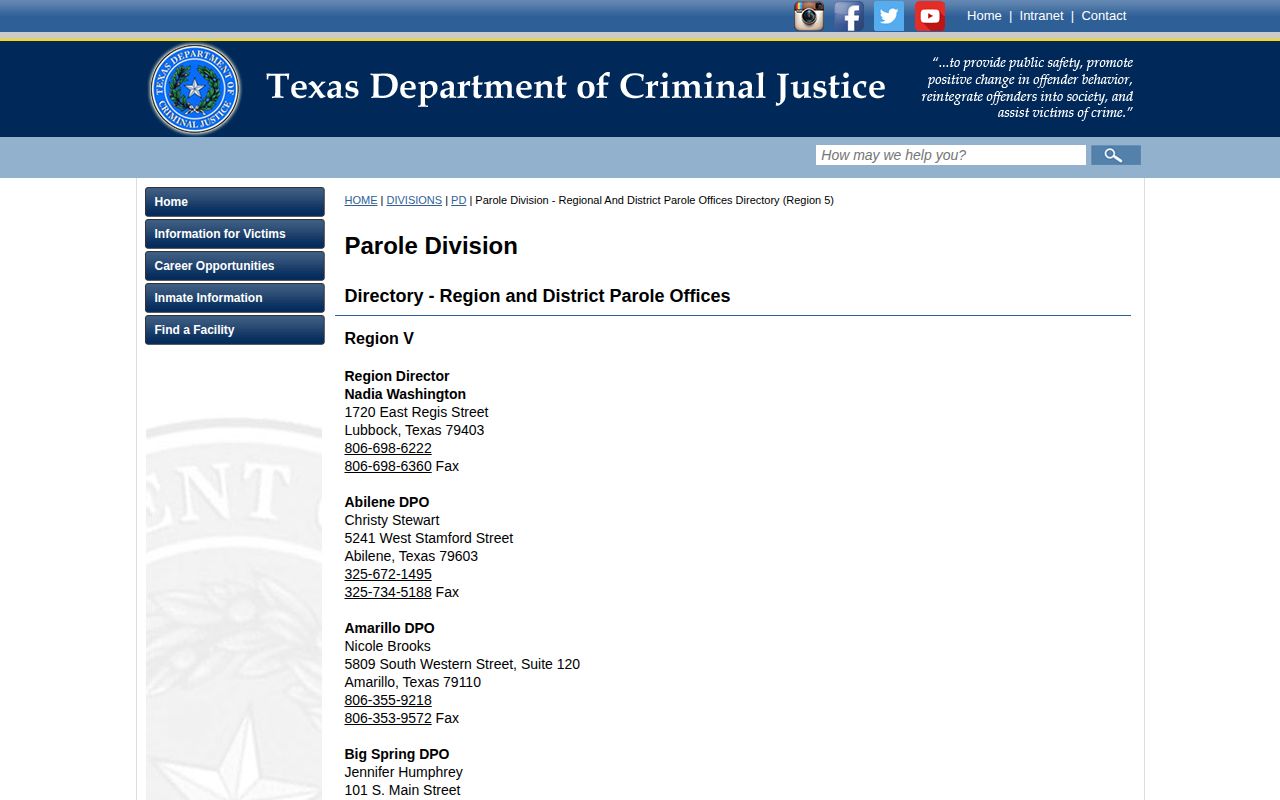
The captured listing distinguishes parole from court probation. Check the live directory after a move because supervision can transfer districts while the Howard County case stays the same.
Howard County Supervision Violations
Conditions vary by the order and person. Common subjects include reporting, travel, programs, fees, and obeying the law, but the signed order controls. No authoritative public Howard County parole-absconder or probation-absconder list was found. A missed report or alleged violation may lead to a warrant, yet it is not a final revocation decision.
TDCJ's revocation process describes administrative review for state releasees. Depending on the issue, a preliminary hearing and a revocation hearing may occur. A parole panel can continue supervision, impose another sanction or placement, or revoke release. Court probation follows the sentencing court's process instead. Check the clerk file for a motion, warrant, hearing result, and signed order. Do not publish a person's reporting plan, home address, or movements.
TDCJ IVSS can provide state custody, parole, and mandatory-supervision notifications. It is informational. A sheriff, court, TDCJ, or Board record must confirm the legal event.
Howard County Supervision Discharge
Supervision can end through expiration, early termination where authorized, completion and discharge, revocation, or a new custody status. The durable proof differs. For probation, seek the court's order discharging or terminating community supervision. For parole or mandatory supervision, use the TDCJ record and obtain agency clarification if the public detail is incomplete.
A person may leave the Howard County Detention Center yet remain under another authority. Transfer to TDCJ, federal custody, another county, or immigration custody is not community release. The county jail book-out and the receiving agency's record should be read together. The Howard County released-inmate search explains that custody handoff path and the underlying release record.
Texas Government Code Chapter 508 governs parole and mandatory supervision. Section 508.145 addresses eligibility, but eligibility is not a grant. Section 508.149 lists mandatory-supervision exclusions. The offense date and judgment can change which law applies, so a public date should never be recomputed as a firm promise.
Transportation After TDCJ Release
TDCJ documents a practical state-release step that matters to Howard County families. Its Parole Division FAQ says the state supplies release clothing and, when another ride is unavailable, a bus ticket. Family pickup may occur at the designated release unit. This is TDCJ policy, not a promise about release from the Howard County jail.
Confirm the release unit and date through TDCJ before making travel plans. A favorable Board vote can still depend on a program, approved residence plan, detainer resolution, or another prerequisite. The release-status line, not the projected date alone, is the useful last check. If TDCJ names a different unit, plan around that unit rather than the Big Spring parole office, which supervises after release and is not necessarily the exit point.
Which Big Spring Office?
Use the source of the supervision order as the routing test. A Texas prison release on parole or mandatory supervision belongs with TDCJ at 101 S. Main. A Howard County court judgment imposing community supervision belongs with the multi-county CSCD at 315 Main. A federal sentence may include federal supervised release, which is administered through the federal probation system rather than either local office.
Keep a case number, TDCJ or SID number, full name, and date of birth ready. Ask a narrow question about public status or the correct office. That approach reduces same-name errors and respects limits on personal supervision information.
Howard County Parole Review Records
Texas does not hold a formal public hearing for an ordinary parole or mandatory-release decision. The Parole Panel Review FAQ says members review and vote files individually. There is no honest inmate-by-inmate public hearing calendar to search. The rolling process, TDCJ offender detail, and Board result channels are the relevant records.
The review-process page says Parole Division identifies a case roughly six months before initial eligibility and four months before a later review. An institutional parole officer interviews the prisoner and prepares a summary. Three panel members vote in sequence, and two matching votes produce the result. A denial includes another review setting where applicable. Approval may impose conditions.
Decision codes need their live official meanings. The Board's voting-options page lists FI approval codes, program-conditioned codes, RMS, NR, SA, DMS, and sentence-related variants. A favorable code is not a release timestamp. New facts may cause reconsideration or withdrawal, and release processing may remain incomplete.
Administrative revocation hearings are different. They address alleged violations after release rather than the initial decision to grant parole. Keep those processes separate when checking Howard County post-release supervision.
Final Howard County Supervision Check
A Board result does not prove which Big Spring office now supervises the person. Confirm completed release, then use the assigned district information. If a Howard County court ordered probation instead, return to the judgment and CSCD. This source check keeps a parole code from being mistaken for probation or discharge.