
Howard County Projected Versus Actual
A projected date answers what may happen if current sentence data, credit, eligibility, and release conditions stay the same. An actual release date records a completed custody event. TDCJ may display Projected Release Date, Maximum Sentence Date, Parole Eligibility Date, and parole-review information together. None should be read alone.
A pretrial detainee has no sentence-based date. Bond, court action, holds, and jail processing control the exit. A person serving a county sentence may have a jail-computed date. A state prisoner may have a TDCJ projection. A federal prisoner belongs in the BOP system.
Lookup Howard County Release Dates
Start with the present custodian. A name disappearing from the Howard County roster can mean release, transfer, or a portal change.
- Confirm whether the person is at the Howard County Detention Center, TDCJ, BOP, or another agency.
- For county custody, call 432-264-6051 and ask whether the person is pretrial or sentenced. For a county sentence, request the jail's computed date and source records.
- For state custody, use the TDCJ Inmate Information Search by TDCJ number, SID, or name and birth date.
- Read status and location with Projected Release Date, Maximum Sentence Date, Parole Eligibility Date, and review information.
- Check the judgment, jail credit, and later court orders in the proper clerk file.
- Confirm an imminent state release with TDCJ, then verify the completed event.
The sheriff links its Judicial and Jail Record Search, but Howard County publishes no projected-date calculator. The Howard County release-record path explains how to request a precise book-out or transfer record.
The official TDCJ search form documents the state lookup fields.
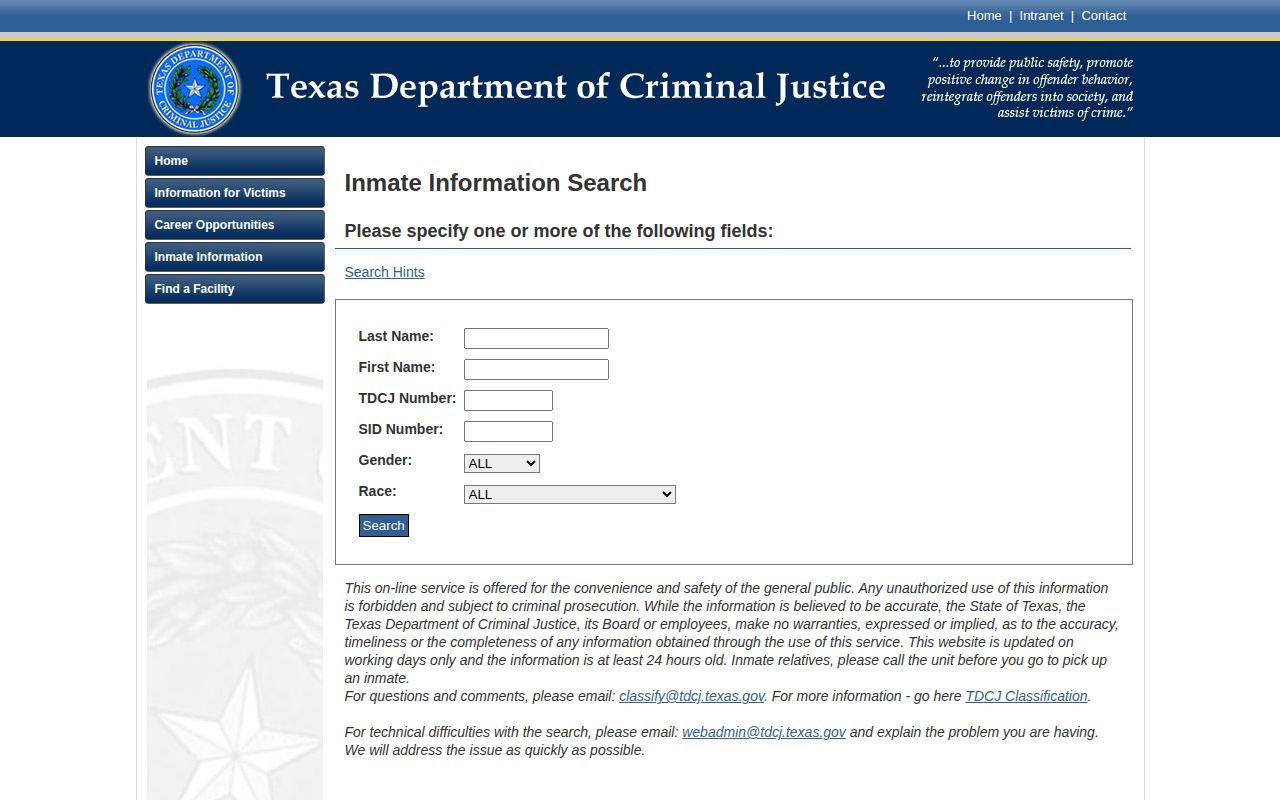
The capture shows the source form, not a promise that every record has a projected date. Read the live detail and its as-of status.
Texas Good Time and Release
A state calculation begins with every judgment, sentence start date, jail credit, and whether terms run concurrently or consecutively. The law on each offense date matters. So do the offense category, any deadly-weapon finding, time-credit class, forfeitures, parole eligibility, mandatory-supervision eligibility, Board action, programs, detainers, and release-plan approval.
Texas Government Code Chapter 498 governs state good-conduct time. Section 498.003 says good time can affect classification and eligibility where allowed, but it does not reduce the judicial sentence itself. Section 498.004 permits forfeiture. Sections 508.147 and 508.149 govern mandatory-supervision mechanics and exclusions.
Texas has no universal 85-percent rule. Section 508.145(d) uses a one-half actual-calendar-time or 30-year threshold, whichever is less and subject to statutory details, for listed serious categories. Other cases follow different rules. Never calculate a named person's date from a slogan.
Why Howard County Dates Change
A projection moves when its inputs change. Even a favorable parole vote may carry a program, residence-plan, or detainer condition that delays physical release.
| Change | Effect | Best check |
|---|---|---|
| Amended judgment or corrected credit | Moves the calculation | Court order and custodian |
| Consecutive sentence | Extends the custody sequence | All judgments and TDCJ detail |
| Good time lost or restored | Changes eligible timing | TDCJ calculation |
| Board approval or denial | Changes the supervised-release path | Parole Review Information |
| Program or release plan | Approval may not yet produce release | Review and Release Processing |
| Detainer, warrant, or new sentence | Can cause continued custody or transfer | Holding and receiving agencies |
A detainer is notice that another authority may take custody. It can turn a jail or prison exit into a transfer, not release to the community.
Confirm Howard County Release Dates
For TDCJ help, call 936-295-6371 or 800-535-0283 on weekdays. Its defined-field email route at pia@tdcj.texas.gov can supply location, history, and projected-date information. After a favorable parole vote, Review and Release Processing at 512-406-5202 is the focused status channel. The Board line at 844-512-0461 addresses review results, not the exit time.
Set an alert through the Howard County VINE inmate check, using IVSS-Counties for county custody or TDCJ IVSS for state custody. Alerts may lag. Confirm the completed event with the sheriff or TDCJ.
For federal custody, search the BOP Inmate Locator. It may show a release date and that a person is no longer in BOP custody. That does not prove where the person went.
Howard County Sentence Date Sources
Howard County publishes no local good-time table. For a county sentence, Code of Criminal Procedure Article 42.032 authorizes sheriff-awarded good-conduct commutation up to the statute's limit, while Article 42.03 addresses credit. Ask for the jail's computed date, judgment, jail-credit record, and later orders. Do not apply a TDCJ formula to a county sentence.
For pretrial custody, request the bond and hold picture. The portal separates Jail Records from Jail Bond Records, but a bond entry is not a completed book-out. Another hold or processing step may keep the person in custody. The sheriff's timestamp and disposition supply the final county check.
A disposition can change the path without fixing an exact exit minute. Dismissal, time served, probation, remand, or transfer each creates different records. Remand means the court returns the person to custody. Match the order to the jail record.
Texas Projected Date Meanings
For certain pre-September 1996 offenses eligible for mandatory supervision, TDCJ explains that the projected date may be the mandatory release point if parole has not occurred. Later mandatory supervision is discretionary. For an excluded or denied person, the field can correspond to discharge rather than earlier supervised release.
Parole Eligibility Date only marks when consideration may begin. Maximum Sentence Date reflects the sentence endpoint under the recorded calculation. Projected Release Date is the current estimate. Read all three with status, offense-date law, and Board information. Blank or “not available” fields should stay blank, not be filled through arithmetic.
When the public record is unclear, use TDCJ's official phone or email route. Ask for the exact field, its as-of date, and whether a displayed date is projected release, maximum sentence, or parole eligibility. That distinction prevents a plausible estimate from becoming a false promise.
Howard County Release Date Review
Build a clean date record before calling an agency. Note the full name, date of birth, booking or corrections number, current custodian, offense date, case number, and the date each public field was checked. If several cases exist, list them separately. Concurrent sentences run at the same time; consecutive sentences run one after another. Missing a second judgment can make a date appear wrong.
For a county case, compare the signed judgment with credited days and the jail's computation. The District Clerk handles felony records, while the County Clerk handles county misdemeanor matters. Use the court tied to the charge. A municipal record may document a Big Spring Police matter but does not replace the county jail book-out once a person was booked there.
For a state case, the Board reviews parole separately from TDCJ's sentence calculation. Texas ordinary parole review is a file-vote process, not a public hearing calendar. The result may show approval, denial, or a program condition. Check the current Board voting options for code meanings and use the review-results channel for the latest decision.
For federal custody, PACER may show the judgment, sentence reduction, or revocation that explains a BOP date. A BOP FOIA request can seek agency records not shown in the public locator. Federal supervised release is not Texas parole.
Verify Howard County Actual Release
Close the loop after the projected day passes. Ask the Howard County jail whether the person was booked out, the effective time, the release reason, and whether another agency received the person. For TDCJ, confirm discharge or release status and supervision. For BOP, read the locator status with any federal docket updates.
Do not treat “no longer here” as a complete answer. The phrase can describe a community release, state transfer, federal handoff, immigration custody, hospital movement, or another county. Request the destination or receiving agency when that information is releasable.
Keep the final source with the earlier projection. That comparison shows whether the estimate changed and prevents an old screenshot from being reported as the actual event. If the records conflict, the agency that held custody at the disputed time is the first office to ask.
Track Howard County Date Updates
Record each date with its exact label, source, displayed value, retrieval date, custodian, and status text. Add a new entry when the value changes instead of replacing the old one. That makes the sequence clear without guessing why the agency updated its calculation.
Call with a focused discrepancy. State which projected date appeared on which day and what the live record now shows. Ask whether corrected credit, a court order, Board action, a program, a detainer, or an administrative correction caused the change. The office may limit details, but it can route a precise field question.
Do not announce an estimate as a pickup time. Release processing can include identity checks, property, paperwork, transport, and coordination with another custodian. Howard County publishes no special weekend-release calendar. Confirm the release unit and completed status before travel.
When Howard County Dates Pass
Use the same caution after a projected date passes. A stale field may reflect a denied release plan, another sentence, transfer, or an unposted correction. Search the current location, ask whether the date was recalculated, and request the record of what followed. If the answer is transfer, begin with the receiving custodian instead of describing the person as free.
An amended judgment can also change the calculation. The clerk supplies the signed order, while the jail or TDCJ applies it to custody. Compare both sources before resolving a disputed Howard County release date. Keep the source and its as-of date with the answer.